Mini Split Installation in Hawthorne, NV
A new system here will heat from October through May and cool from July through August every year. Tell us about the house, and a licensed contractor who covers Mineral County will get in touch.
Tell us about the job
It takes about a minute.
Hawthorne asks a mini-split to run most of the year
A mini-split here heats or cools the house 10 months out of the year. Heat runs October through May, when winter nights average 22°F. Cooling takes over in July and August, when afternoons average 86°F. That split means the compressor spends far more of its life pulling heat in than pushing it out.
Almost half the homes here heat with propane, so a new mini-split may be carrying the heating load on its own or working alongside a propane system on the coldest nights. Any unit installed new has to meet the federal minimum for a split-system heat pump, 14.3 SEER2 for cooling and 7.5 HSPF2 for heating. With heat season this long, the HSPF2 number says more about how the unit will perform in your house than the cooling number does.
- 8 months
- October through May, your system heats
- 2 months
- July through August, it cools
- 22°F
- the average winter night it heats against
- 86°F
- the average summer afternoon it cools against
NOAA nClimDiv, 1991–2020 normals
Nevada requires HVAC contractors to hold a state license.
The Nevada State Contractors Board tests contractors before licensing them and keeps a record of who holds a license. That license belongs to the contractor, not to any one job. Once someone holds it, they can take on a mini-split installation anywhere in the state without applying again for that project.
The license is what stands behind the person doing the work. The installation itself still goes through a separate check. In most cities and counties, putting in a mini-split needs a permit from the local building office and an inspection once the work is done. The permit and inspection cover the installation. The license covers who did it.
Sources: Nevada Legislature · Nevada State Contractors Board
- Is a mini split worth it?
- For most homes here, yes, especially if propane heat is what you're trying to get away from. A mini split handles both your heating and cooling from one system, and with winter lows averaging 22°F and lasting from October through May, having a heat pump that covers eight months of the year matters. Whether it's worth it for your house depends on how many rooms you need covered and what's heating those rooms now, so a contractor should look at the specific setup before you decide.
- How many rooms can a mini split cover?
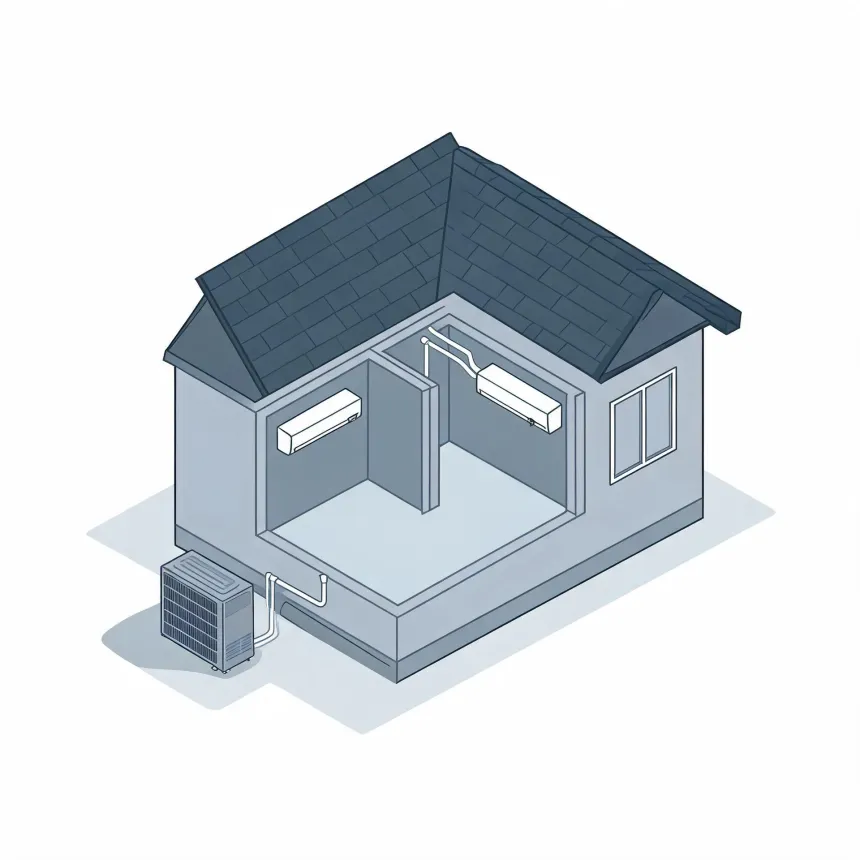
- A single outdoor unit can run up to eight indoor heads, depending on the system. Each indoor head is sized for the room it's in, so a contractor picks the number of heads and their capacity based on the square footage and layout of your house. Some homes only need one or two heads to cover the main living space, others need a head in nearly every room.
- Can a mini split heat a whole house?
- Yes, if it's sized and placed for that. A multi-zone mini split with a head in each room can heat the entire house, and the heat pump itself works down to well below freezing, which matters here where winter nights average 22°F. The question is whether enough heads are installed in the right rooms to reach every part of the house, and that's something a contractor works out room by room.